
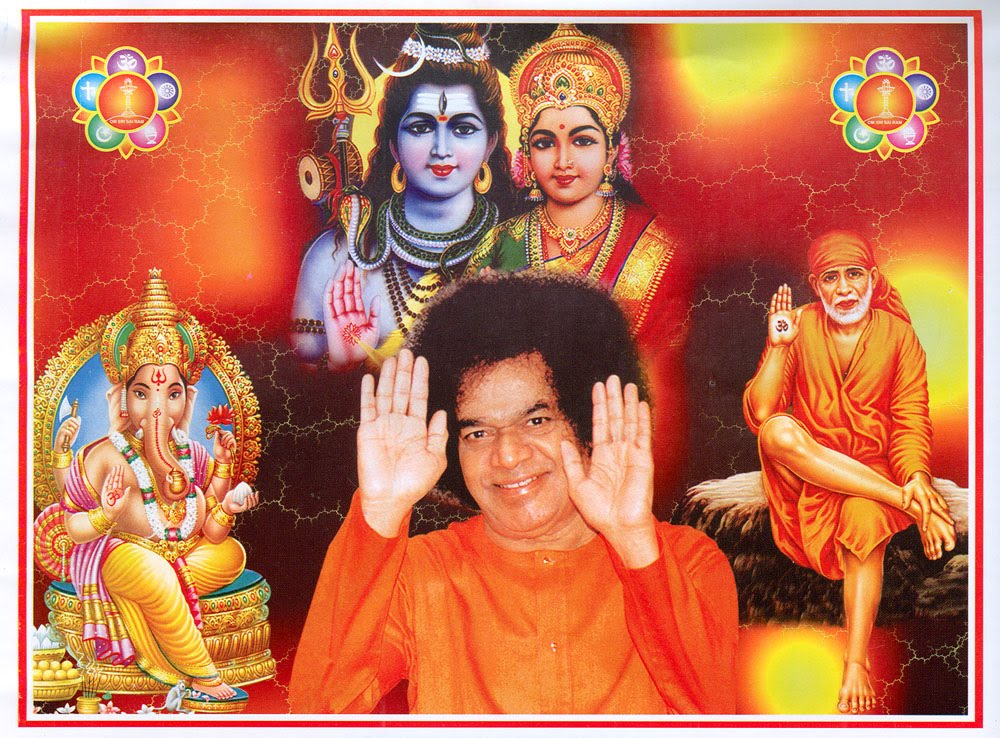
 Shiva
is
the god of the yogis, self-controlled and celibate, while at the same
time a lover of his spouse (shakti). Lord Shiva is the destroyer of the
world, following Brahma the creator and Vishnu the preserver, after
which Brahma again creates the world and so on. Shiva is responsible
for change both in the form of death and destruction and in the
positive sense of destroying the ego, the false identification with the
form. This also includes the shedding of old habits and attachments.
Shiva
is
the god of the yogis, self-controlled and celibate, while at the same
time a lover of his spouse (shakti). Lord Shiva is the destroyer of the
world, following Brahma the creator and Vishnu the preserver, after
which Brahma again creates the world and so on. Shiva is responsible
for change both in the form of death and destruction and in the
positive sense of destroying the ego, the false identification with the
form. This also includes the shedding of old habits and attachments.
 Another
form is the Nataraj. Shiva Nataraj's dance represents both the
destruction and the creation of the universe and reveals the cycles of
death, birth and rebirth. His Dance of Bliss is for the welfare of the
world. In the pose of Nataraj, the King of Dance is giving darshan to
his beloved devotees within the "Hall of Consciousness", which is the
heart of man. Under his feet, Shiva crushes the demon of ignorance
called Apasmara Purusha, caused by forgetfulness. One hand is stretched
across his chest and points towards the uplifted foot, indicating the
release from earthly bondage of the devotee. The fire represents the
final destruction of creation, but the dance of the Nataraj is also an
act of creation, which arouses dormant energies and scatters the ashes
of the universe in a pattern that will be the design of the ensuing
creation.
Another
form is the Nataraj. Shiva Nataraj's dance represents both the
destruction and the creation of the universe and reveals the cycles of
death, birth and rebirth. His Dance of Bliss is for the welfare of the
world. In the pose of Nataraj, the King of Dance is giving darshan to
his beloved devotees within the "Hall of Consciousness", which is the
heart of man. Under his feet, Shiva crushes the demon of ignorance
called Apasmara Purusha, caused by forgetfulness. One hand is stretched
across his chest and points towards the uplifted foot, indicating the
release from earthly bondage of the devotee. The fire represents the
final destruction of creation, but the dance of the Nataraj is also an
act of creation, which arouses dormant energies and scatters the ashes
of the universe in a pattern that will be the design of the ensuing
creation.  The
Mahamrityunyaya form of Shiva is the great conqueror of death. The
Mahamrityunjaya mantra is one of the two main mantras of the Vedas,
next to the Gayatri mantra. It is chanted to remove death and disease.
This form of Shiva also is the being of pure joy, referring to the
unconditioned enjoyment of the perfectly peaceful mind. That is the
true nature of the divine elixir that this Shiva offers his devotees in
no less than four hands.
The
Mahamrityunyaya form of Shiva is the great conqueror of death. The
Mahamrityunjaya mantra is one of the two main mantras of the Vedas,
next to the Gayatri mantra. It is chanted to remove death and disease.
This form of Shiva also is the being of pure joy, referring to the
unconditioned enjoyment of the perfectly peaceful mind. That is the
true nature of the divine elixir that this Shiva offers his devotees in
no less than four hands. - the trident that represents the three gunas
- the snakes that show he is beyond the power of death and poison and also stand for the Kundalini energy.
- the sound of Shiva's two-sided drum maintains the rhythm of the heartbeat and creates the sound AUM in the overtones.
- the vehicle of Shiva is the white bull called Nandi (the joyful).
- Shiva is often seated on a tiger skin or wears a tiger skin, with the tiger representing the mind.
- Shiva lives on Mount Kailasa in the Himalayas.
 The
power
or energy of Shiva is Shakti, his spouse, of which Parvati is probably
the most popular form. Shiva's first wife was Sati and his second wife
was Parvati. They are also known by many other names, such as Uma,
Gauri, Durga, Kali, Annapurna and Shakti. His sons are Ganesha and
Kartikeya.
The
power
or energy of Shiva is Shakti, his spouse, of which Parvati is probably
the most popular form. Shiva's first wife was Sati and his second wife
was Parvati. They are also known by many other names, such as Uma,
Gauri, Durga, Kali, Annapurna and Shakti. His sons are Ganesha and
Kartikeya. The
Shiva
Lingam
The
Shiva
Lingam Some unique attributes of Lord Shiva
1. Physical attributes
a. Ganga :
Just as the sun is the focal point of the solar system and the soul
that of the body, the focal point of divine consciousness (chaitanya) in
every object and pure particles (pavitrakas) is ga-aum. The flow from
which ga-aum originates is gan gaha = Ganga. Ga-aum flows from Shiva's
head. This is called the descent of the Ganga from Shiva's head. Since
the river Ganga has a fraction of the principle of the spiritual Ganga,
no matter how polluted it becomes, its purity is perpetually retained.
Hence, when compared to any other water in the world, the water from the
Ganga is the purest. This is realised not only by those who can
perceive the subtle dimension but also by scientific researchers.
b. Moon :
Shiva adorns the chandra (moon) on His forehead. The point where the
three frequencies - affection (mamata), mercifulness (kshamashilata) and
motherly love (vatsalya) originate is referred to as the chandra
(moon). Thus, one can conclude that chandrama (the moon principle) is
the state in which the three attributes of affection, mercifulness and
motherly love are present.
c. Third eye : Shankar
is three-eyed, i.e. He can perceive events of the past, present and
future.According to the science of Yoga the third eye means the Sushumna
nadi (channel).
d. Serpent : One of the Names
of Lord Shankar is Bhujanga-patihari. Bhujang means a serpent or pure
particles (pavitrakas), pati means the nurturer and hari means one with a
garland around His neck. Bhujangapatihari thus means the One who
nurtures pure particles and wears them like a garland. Various serpents
represent groups of pure particles. Though externally they appear like
serpents, internally they are a kind of ladder. To make spiritual
progress one has to climb up holding onto the tail of the serpent. Lord
Shankar adorns serpents at nine points on His body - one on the head,
one around the neck, one on each arm, one on each wrist, one around the
waist and one on each thigh. This implies that His body is comprised of
pure particles or that serpents of pure particles play all over the body
of Lord Shankar who has the universe as His form.
2. Spiritual attributes
a. One performing severe austerities and the great yogi
Shiva
is always seated in a bandha or a mudra. His temperature rises due to
heat generated by performing severe austerities; Hence, He uses the
Ganga, the moon and serpents which endow a cooling effect and lives on
the snow-clad Kailas mountain.
b. Short tempered
If
someone disturbs His meditation the radiance generated by spiritual
practice will be suddenly expelled and whoever is in front of Him will
not be able to tolerate it, and gets destroyed. This is referred to as
being 'reduced to ashes by Shankar's opening of the third eye'.
c. One who is willing to undergo any distress for the sake of imparting happiness to others
The
poison generated during the churning of the celestial ocean
(samudramanthan) was burning the entire Universe but no deity came
forward to accept it. At that time Shiva drank that poison and saved the
world from destruction.
d. One who has both, deities and demons, as His worshippers
Neither
did demons like Banasur, Ravan, etc. worship Lord Vishnu nor did Lord
Vishnu bestow any boon upon any demon. However, they worshipped Lord
Shiva who blessed them.
e. Master of the spirits
Since Lord Shiva is the master of spirits, His worshippers are generally not possessed by them.
Science in the worship of Lord Shiva on Mahashivratri
The function of the 'Shivpindi'

1. Emitting waves of Knowledge, Devotion and renunciation
2. Emission of subtle vibrations of chaitanya, bliss and peace
3. Receiving the 'tarak or marak tatva (element)' as required
Lord Shiva

| Cremation ground: Shiva sitting in the cremation ground signifies that He is the controller of death in the physical world. | Matted locks: The three matted locks on the head of the Lord convey the idea that integration of the physical, mental and spiritual energies is the ideal of yoga. |
| Tiger skin: A tiger skin symbolizes potential energy. | The crescent moon: The crescent moon is only one of His ornaments. |
Three eyes: Lord Shiva, also called Tryambaka Deva, is depicted as having three eyes: the sun is His right eye, the moon the left eye and fire the third eye. | Nandi: The bull is associated with Shiva and said to be His vehicle. |
Kundalas (two ear rings): Two Kundalas, Alakshya and Niranjan in the ears of the Lord symbolize the Shiva and Shakti (male and female) or Ardha-Nariswara principle of creation. | Kamandalu: A water pot (Kamandalu) made from a dry pumpkin contains nectar and is shown on the ground next to Shiva signifies that, an individual must break away from attachment to the physical world and clean his inner self of egoistic desires in order to experience the bliss of the Self. |
| A snake (Vasuki Naga): The snake is shown curled three times around the neck of the Lord and is looking towards His right side. The three coils of the snake symbolize the past, present and future - time in cycles. | Rudraksha necklace: Rudra is another name of Shiva. Rudraksha necklace worn by the Lord illustrates that He uses His cosmic laws firmly - without compromise - to maintain law and order in the universe. |
| Ganga: Ganga, symbolically represented on the head of the Lord by a female (Mother Ganga) with a jet of water emanating from her mouth and falling on the ground, signifies that the Lord destroys sin, removes ignorance, and bestows knowledge, purity and peace on the devotees. | Snake around the neck: The snakes to symbolize the yogic power of Lord Shiva with which He dissolves and recreates the universe. |
| Varda Mudra: Lord Shiva's right hand is shown in a boon- bestowing and blessing pose, which annihilates evil, grants boons, bestows grace, destroys ignorance, and awakens wisdom in His devotees. | Trident (Trisula): A three-pronged trident shown adjacent to the Lord symbolizes His three fundamental powers (shakti) of will (iccha), action (kriya) and knowledge (jnana). Damaru (drum): Damaru symbolizes the two utterly dissimilar states of existence, unmanifest and manifest. |
| Half-open eyes: When the Lord opens His eyes, a new cycle of creation emerges and when He closes them, the universe dissolves for creation of the next cycle. The half-open eyes convey the idea that creation is going through cyclic process, with no beginning no end. |








 Entradas










No hay comentarios :
Publicar un comentario